Intermountain Humane Society regularly gets animals in that have serious
medical problems or are surrounded by special circumstances that inspire the
interest of the public. We hope that this information will educate and
inspire the public concerning the plight of individual animals and specific
humane issues surrounding these animals.
Gus
Gus
is a 5 year old Great Pyrenees with a story. His owners decided to move to
Hawaii and leave Gus behind. We took Gus in, without realizing that Gus
has some back and neck problems. When he first came to us, he couldn't
lift his rear end off the ground to walk. He could bunny hop for a few
feet, but then he would need to rest. A big, friendly dog, whenever
someone would approach his kennel, he would do his best to drag himself to the
door in order to greet his visitors. As is typical of this breed, he went
into depression from being abandoned, and for almost a week he would eat
nothing. Here at the shelter we spent a good deal of money, some of which
was left to us by his previous owners, to find out just what was wrong.
Finally we took him to a holistic vet, who performed accupuncture and
chiropractic services on this big dog. Gus, ever the gentle giant,
held up like a trooper, and didn't even flinch. Two days after the
treatment, Gus went on his first real walk - no laying down, no bunny-hopping,
head held up high and proud. Today Gus sleeps on a magnetic mattress,
bowls over his foster mom in his eagerness to go for walks, chows down on
chicken, rice, and dog chow like a 150lb dog should. Now here's the sad
part - Gus will probably need to continue to see a chiropractor and
accupuncturist for the rest of his life. Gus needs a home where he
will not only receive love, but also the treatments to keep this big guy feeling
good. He is wonderful around children, other dogs, cats, and people.
His foster mom has a seven month old son who routinely sits on him and pulls his
ears. Gus just smiles, happy for the attention and peacefully awaiting a
new home.
Cassidy
Cassidy is a 6 week old kitten brought to IMHS on 6-17-02 after being found
in Conifer. He has a severly dislocated leg (hock/ankle joint) which will
need to be repaired surgically. Please visit our website for updates on
Cassidy's situation.
Sheeba
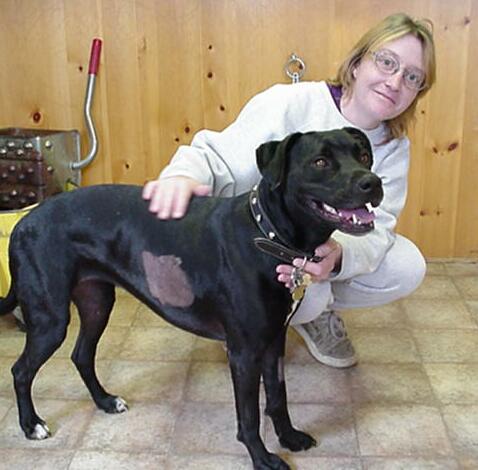 Sheeba
and new guardian Tammy Cornell
Sheeba
and new guardian Tammy Cornell
Sheba is a young Labrador Retriever/Pit
Bull mix who is very gentle and sweet and not aggressive with other dogs.
Sheba was given to a family in Bailey because her people were leaving the
area. They really loved Sheba, but having another dog and living in a
small apartment made it somewhat difficult. Sheba stayed with this family
for a month, until she was given to the son of a neighbor who really wanted the
dog. Unfortunately for Sheeba, this did not turn out well. In
late April, Sheeba was hit by a car on 285. Park County Animal Control
Officer Kammy Lyons responded to the scene and transported the dog to Lone Rock
Veterinary Clinic. Sheeba was in very serious condition, with brain
swelling, lung bruising and air leaking from a lung lobe into the surrounding
area of the chest. The air in the chest (called a pneumothorax) is very
dangerous and can cause collapse of all the lungs and death. The brain
injury causes pinpoint pupils, loss of awareness and can easily be fatal.
Sheeba was treated with medication to help relieve the brain swelling and air
was removed from her chest several times during the first day in the
hospital. She improved somewhat, but during the first 24 hours, she could
easily have died at any time. Sheeba luckily continued to improve and was
released from the hospital a week later, still sore, but breathing well and
fully alert and recovered from her bruised brain. Sheeba is returning to
the family that had her for a month previously. They are very committed to
Sheeba and have made her a permanent part of their family. IMHS is helping
them pay for the veterinary services in this unusual case under our rescue
budget and Lone Rock Veterinary Clinic discounted the bill heavily. If
anyone would like to assist Sheba, we are taking donations on behalf of Sheeba.
Donations can be dropped off at the Bailey Country Store, Park County Animal
Control, Lone Rock Veterinary Clinic, or sent to P.O. Box 1250, Conifer,
CO 80421.
George
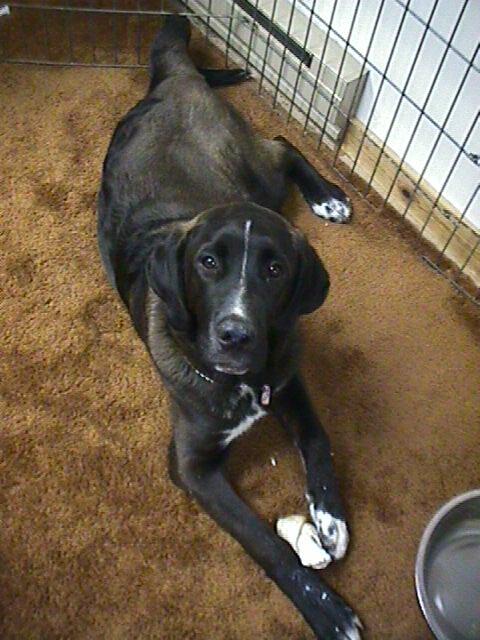 Georges
Plight
Georges
Plight
George is perhaps one of the most loveable dogs you could hope
to meet. George was picked up as a stray by Park County Animal Control, so
his history prior to this point is a mystery. George is a young (8 months
old in March of 2001) male dog, probably a Saint Bernard-Labrador Retriever
Mix. George spent several weeks at the Park County Animal Control Facility
in Bailey before being transferred to an IMHS shelter home. Lone Rock
Veterinary Clinic performed and examination, vaccinations and neuter for George,
and it was noted that George did not seem to walk right. X-rays revealed
that George's hip joints were very lax and the ball was poorly seated in the
socket of the hip. Specialists were consulted concerning George's
condition and it was generally agreed that George's condition appeared to be
moderate hip dysplasia. Plans were made to provide a surgery for George,
called a Tripple Pelvic Osteotomy, by which George's hip joints could be
reconfigured to improve the seating of the ball in the socket and allow George
to have a normal life. The cost on this surgery would be extensive, and
would have cost as much as $4000 normally. Dr. Marlon Neeley, from Veterinary
Referral Center of Colorado agreed to do the surgery at Lone Rock Veterinary
Clinic at a dramatically reduced rate of less than half of normal
charges.
On the Day of the Big Surgery, George Receives a Tremendous
Present!
On the morning of his surgery, George
received a special surprise. Dr. Marlon Neeley and Dr. Kevin Dennison
performed X-rays on George to under general anesthesia to update themselves on
the conformation of George's hips and to measure the laxity of the hip joints
through a special view called a DAR view (dorsal acetabular rim). They
were astonished to find George's hips had progressed dramatically and George
should be fine without surgery. Apparently, his hips became loose due to a
combination of reduced exercise while initially in the kennel and other factors,
such as poor diet, that might have influenced George's condition prior to being
picked up as a stray. This degree of improvement is rarely seen on such a
dramatic scale, making this truly a cause for celebration for George.
George is in the process of being adopted by a family who absolutely loves him,
where he will join several other dogs. April's Mountain
Connection features an article that describes Georges situation prior to
his second set of X-rays. Any local supporters who donate money toward
George's surgery can be assured that these funds will be put to valuable use in
the treatment of animals needing help in special circumstances.
Rusty
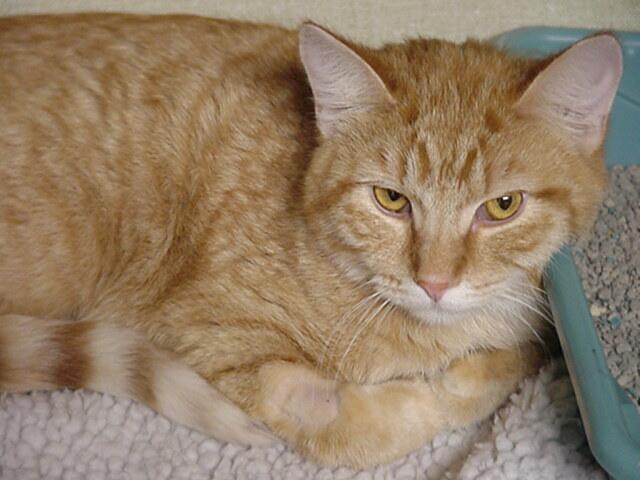
Rusty is a young neutered male orange tabby cat who was
adopted from IMHS by a local family late in the year 2000. Unfortunately,
Rusty swallowed a string during play one day, without the owners
knowledge. Rusty became very ill, not eating, vomiting and showing signs
of serious illness. These signs had persisted for several days. The
family had recently located to our area and had recently been faced another
challenge of tremendous emotional and financial proportions, that of a daughter
with a brain tumor. The family felt they were unable to financially deal
with the costs of exploratory surgery and a uncertain prognosis.
Intermountain Humane Society had adopted Rusty to them and Dr. Kevin Dennison
(owner of Lone Rock Veterinary Clinic and President of Intermountain Humane
Society) felt that Rusty's life was worth trying to save. The family
agreed to relinquish Rusty back to IMHS for treatment.
Rusty went to surgery that very
afternoon. Dr. Dennison performed the surgery and found that the string
had cut the bowel in numerous places, causing a severe infection, called
peritonitis and damaging large sections of his small intestine. Strings
form what veterinarians call linear foreign bodies, meaning they cause
the bowel to bunch up on the string, much as a curtain bunches up on a curtain
rod. If discovered and corrected promptly, the problem can be corrected
with minimal problems through surgery. If the condition persists for more
than 24-36 hours, however, the string starts sawing small holes in the
intestine, resulting in bowel leakage, peritonitis and severe damage to the
blood supply of the intestine. In Rusty's case, more than 15 holes existed
in the small intestine and large sections of the bowel were severely
compromised. After carefully removing the string (with a series of cuts on
the exposed string where holes existed and small incisions in the other areas,
Dr. Dennison decided to proceed with steps to attempt to save Rusty's life, even
though the prognosis was guarded. A little over 1/3 of Rusty's small bowel
had to be removed, needing two areas of anastamosis (end to end joining) of the
salvageable bowel. This is nearing the maximum amount of bowel that can be
removed with a possibility of survival. Luckily, the upper section of the
intestine, where the bile duct and pancreas connect to the bowel was fine,
making the prognosis somewhat better.
Rusty remained in intensive care for over 10
days, on IV fluids, IV antibiotics and intense supportive care. Four days
after the initial surgery, Rusty had a short second surgery to determine the
cause of persistent fever. The abdomen actually looked great, except for a
hematoma (a pocket of clotted blood) at the site of one anastamosis.
The hematoma was drained and the area thoroughly cleaned up to reduce the
swelling and inflammation that was causing Rusty's signs. From that time
on, Rusty has shown a consistent improvement and is not eating better, gaining
weight and is much happier. Time will tell if Rusty will have to be on any
medication or special diets long-term, but he is expected to survive.
Rusty will be living with the staff of Lone Rock Veterinary Clinic for a month
or so, to ensure his full recovery from this dramatic problem. After that,
Rusty will need to find a loving home where he can continue his new life which
looked so tenuous for so long. Lone Rock
Veterinary Clinic has generous provided Rusty's services at a mere fraction
of the normal fees. IMHS appreciates the services provided by all the
participating veterinarians, many of whom have provided services of this type
for us throughout the years.
Rusty Update: As of the end of April, Rusty is doing
great. He is gaining weight, eating well and really adjusting well.
Rusty can now go to a permanent home. Unfortunately, Rusty doesn't like to
go to adoption displays. He lives in the house next to Lone Rock
Veterinary Clinic and is doing well, but he gets real hard to catch after going
to displays. He can be seen at Lone Rock Veterinary Clinic.